Sunday, April 10, 2016

Looking at How Other Hospital Unions Are Making Work Better

One main focus of the upcoming contract negotiations for SHARE will be improving the day-to-day experience for SHARE members. To prepare, SHARE is looking at what other hospitals and unions are doing.

The annual IHI (Institute for Healthcare Improvement) conference is a great place to meet people doing innovative work. IHI is a world leader in the effort to improve healthcare, and to make good care available to everyone. The conference brings together healthcare leaders, front-line employees, nurses, doctors, medical students, administrators, and a few of us from organized labor. It was inspiring to be with over five thousand people from all over the world who are trying to make their hospitals better.

Highlights from other unions:
  • UNITE HERE, a union that represents hotel workers in Los Angeles, is running classes for their members (voluntary, of course) in self-management of chronic disease. Many members are feeling healthier, and they are keeping the costs of their health insurance down. (For more info, see link to video, link to report with health outcomes data.)
  • CIR (the Committee of Interns and Residents, a union of doctors), teaches process improvement to new doctors, who are motivated to gain those skills and experiences to use in their careers. You can read about them here, here and here.
  • I got to learn a lot more about the Labor Management Partnership at Kaiser Permanente. The best part was meeting the union & manager co-leaders of unit-based teams in their departments. Kaiser rewards the 30 best unit-based teams every year by sending the co-lead to the IHI conference.
  •  I went to a workshop from Kaiser called "Workers and Patients: A Single Culture of Safety" where they said that the best prevention for injuries is to have a good team, where workers feel free to speak up when they see something that could be improved.
The Labor Management Partnership at Kaiser Permanente is really changing the role of frontline staff at their hospitals, and we want to learn a lot more about how they are doing it. This week, we are hosting a series of meetings with a union and a management leader from Kaiser Permanente -- more on that soon.


Pictured: Maggie Ridings, LPN (right) and Jane Baxter, Nurse Manager. Maggie and Jane are co-leads of a unit-based team in the OB/Gyn department and clinic in Alpharetta, Georgia. One of their team's projects was to develop a system to help their patients be sure to pick the right hospital for their delivery, saving their patients money and helping Kaiser Permanente to keep their healthcare affordable. In another project, they built a garden to encourage healthy living for patients and staff. 


Friday, April 8, 2016

Process Improvement Spotlight: Mapping Out New Solutions in Insurance Verfication

GROWING and GROWING HEADACHES


Even routine work can get confusing quickly around here. As our hospital grows and technology advances, new complexity arises in the day-to-day. Marion Galeckas, an Insurance Verifier in Patient Access Services, has been making sense of that change throughout her twenty-two years working at UMass Memorial. She works in the Insurance Verification Department specializing in auto liability encounters, where the problems are naturally complex.
Not long ago, in the Idea Board huddle in this area, the staff recognized that they could solve some problems by changing how they communicate about them. I talked with Marion a little bit about their process. It’s a model worth sharing.
MOTOR VEHICLE ACCIDENTS: A FAMILIAR MUDDLE?


Marion is part of the team that makes sure a patient’s hospital bills get sent to--and paid by--the correct insurance plan, whether that’s the patient’s health-insurance or auto-insurance company. Marion spends a lot of time investigating accidents. She speaks with local police departments. She collects a lot of details about automobiles and their owners. She’s been at this for a while. She’s sharp. She’s learned a lot. She’s a professional, and treats her work with professional care. And still, she was frustrated.


The trouble was, the folks in Insurance Verification weren’t the only ones collecting this information. “Sometimes I didn’t know how far to take it,” Marion explained, not knowing the point where an employee in another financial department might pick up the work. In the end, the investigatory work was sometimes even being done in triplicate. And still, sometimes, something could somehow get dropped, leaving no-one in the hospital holding a particular piece of important information.


FIXING THE PROBLEMS, FACE-TO-FACE


Marion was frustrated with what felt like a very uncertain and wasteful process, so she put an idea on her department's idea board to pull together all the different people involved. They would do a deep-dive into the process. This idea led the groups involved, including Billing and Care Coordination departments, to come together with for two intense, focused sessions. They mapped the workflow, who should do each piece of it, and how they would communicate about it. The result is a system that’s working much more smoothly. Multiple departments now dedicate a SharePoint site to manage each particular case. And the SHARE members who participated know that if glitches arise in their new process, they have a way to call together another meeting with other front-line employees to make corrections . . . although their new process is working well after the first few months, and they haven’t had to do so.


Marion says that she’s now more regularly satisfied with her work, knowing that she’s handling her part of the process from a clear starting point to a clear finish, and can better review a complete case for accuracy in the end.


Beyond that, it’s in describing the mapping events that Marion seems to me the most enthusiastic. Before the meetings, Marion had been speaking with many of the other participants over the phone, sometimes for years. And yet, this was the first time she’d ever seen many of them face-to-face, and understood the frustrations from their perspectives. “It was really good to have the time to do that,” she said. “We even shared some laughs.”


These personal interactions reminded Marion of the regular rounding that UMass Memorial employees once did. She enjoyed shadowing the work that others were doing, and learned by comparing experiences. She’s excited to see more of this kind of sharing again.
WHAT’S NEXT?

This process map is making big differences in the way the work gets done in Insurance Verification. And it’s only one of many conversations that together can transform our hospital. As we continue to build our network of information among members and across campuses, please let us know if you have an opportunity for improvement in your area, and stay tuned for more here on the SHARE blog.

Sunday, April 3, 2016

SHARE Reps Learn to Use Lean to Improve Their Jobs

One morning in early March, over twenty SHARE leaders from all over UMMHC came together for a special, customized “White Belt” training. We even welcomed a few SHARE colleagues from UMMS who work in related jobs. Our hospital has adopted a "lean methodology," and our union wants to understand that, to know how we can make it work for us. So far, SHARE members’ experience of lean has been uneven: many SHARE members feel that their idea boards are helping make their jobs better, while some have not noticed any change.  Others wonder how to use these tools more effectively.
We began by talking about the purpose of process improvement.  A “good process” is one in which doing a great job is relatively straightforward; in a good process, it is difficult to make a mistake. A “bad process” is unnecessarily complicated, one in which it can be frighteningly easy to make a mistake, leading to high levels of stress and burnout (not to mention worse outcomes).  If you have to struggle against the system to make the right thing happen, leaving you exhausted and frustrated, you’ve got a process that needs improving.  SHARE reps’ stories of processes in need of improvement were hilarious and horrifying, sometimes at the same time.
When some organizations say “lean,” what they mean is “do more with less.” However, SHARE reps learned to substitute an idea of flow, since the point of process improvement is to keep things working smoothly, to remove barriers that get in the way, wasting SHARE members’ time.  Reps learned more about idea board best-practices; many left with ideas about how to improve their department’s board.
One highlight of the morning was a visit from Eric Dickson, CEO of UMMHC, who encouraged the SHARE Reps to "ask what is the problem we are trying to solve?". When a manager or supervisor proposes a process change that an employee is not sure will work, or doesn't understand, Dr. Dickson suggested, rather than just accepting it but being frustrated, or refusing to change, they should ask the manager to clarify the purpose of the change. Ask why. Work to agree about the definition of the problem. He pointed out that when we're on the same page about the problem to be solved, we're more likely to come to consensus about how to solve it.
At the end of the training, the SHARE reps wanted to know more about the flow and problem-solving tools involved in lean. The next step, a “yellow belt” training, is in the works!
All SHARE members can sign up for lean process improvement training (many hundreds have already attended).  You can sign up on Ournet.

Tuesday, March 29, 2016

Who Gets the Extra Time and the Overtime?

In some areas of the hospital, confusion about the distribution of extra time and overtime still exists. We want to make sure you know that, in our last contract negotiations, we worked with the hospital to make the policy simple and clear, and to prioritize the ability of SHARE members to get ET and OT.


If you would like help making sure that the policy is applied properly in the department, if you have questions about it, or if the SHARE members in your department would like to negotiate something different from the contract provisions, please contact the SHARE office. (Some departments have negotiated different arrangements, ones that are designed to better suit the specific needs of the staff and the work in those locations.)


Here’s the full contract language clarifying how any extra time and overtime should be doled out:


SHARE staff shall have priority over non-SHARE staff to be scheduled for extra time and overtime for SHARE position work. In the absence of guidelines negotiated in the department with SHARE staff, the following guidelines will be used: Regular part-time SHARE staff will have their schedule requests for additional time granted prior to the scheduling of per diem staff. Part-time workers and per diems may be scheduled for additional straight time hours prior to scheduling full-time employees for work at overtime pay.


Once a unit schedule is posted and additional hours need to be filled, they will be offered as follows:
  1. Part-time SHARE staff on unit
  2. Part-time SHARE staff from off unit
  3. Per Diem staff for straight time
  4. Full-time SHARE staff

This policy can be found in the context of all of the contract agreement language on page 11 of the online SHARE contract.

Friday, March 11, 2016

Reaching Contract Agreement: How Harvard Did It

Members of our sister union, HUCTW, have just ratified a new contract with Harvard University, with over 98% of the members voting to approve it. We are happy to congratulate the Harvard Union of Clerical and Technical Workers for voting-in this new contract agreement. 

SHARE and HUCTW have a lot in common. Together, the following unions form a coalition of unions known as the New England Organizing Project, or NEOP:
  • the SHARE unions
    • at UMass Medical School, and
    • at UMass Memorial Hospital,
  • the Union of Social Workers at Cambridge Health Alliance, and
  • the Harvard Union of Clerical and Technical Workers (or HUCTW)
Our shared vision includes a shared negotiation philosophy. In our negotiations, both HUCTW and SHARE begin by talking with management about what's important to union members. We listen carefully to what management says is important to them. Some of our goals overlap with those of management, and, of course, some do not. SHARE tries to build on our common ground, though we know we will disagree about other things. Before we start arguing what size piece of the pie we are going to get, we first want to figure out what we can do to grow that pie bigger. We look for ways to find solutions that work for both sides.

Union members got involved at Harvard to show their support for the union's ideas about healthcare. The NEOP unions agree: What happens outside the negotiating room, with union members showing their support, is just as important as what happens inside the negotiating room.

HUCTW and Harvard came to a contract agreement after long negotiations. As Harvard’s student newspaper, The Crimson, reports, Harvard’s most recent negotiations were long and frustrating. To focus discussions and hone interests, HUCTW and the University involved a team of professional mediators.

You can visit the HUCTW website to find a summary of the outcomes, as well as the complete language of the tentative agreement which has since been ratified by the members.
Every negotiation is different, from institution to institution, and with each successive contract. The next SHARE negotiations will evolve based on the interests of SHARE members and the needs of our hospital.  The strong success at Harvard inspires us to further develop our interest-based negotiation methods as we work to advance our wages and benefits, and create new and ambitious structures for improving our workplaces.

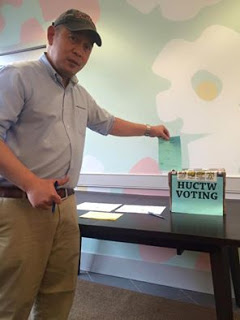
HUCTW member Noel voting in his first ratification vote at Harvard's Dumbarton Oaks location. Employees at this site, located in Washington D.C., recently voted to join Harvard's union.

Sunday, March 6, 2016

SHARE PCAs, LPNs, and MAs – Do you want to go back to school?

SHARE, Worcester State University and UMass Memorial have put together a program to help you get started at college.

It's affordable, at a convenient time and place, and not scary! This program is designed for people who may not have been in a classroom for a long time. You earn 9 or more college credits, which you can transfer to other colleges if you want. You get coaching and support, and you get help making a plan for continuing your education at the end. Your classmates will be other SHARE members in the same boat.

Convenient time: You can do the classes during the day or in the evening. The first group will meet one evening per week (Wednesdays 4:30-7:30pm), starting in April 13th and going through October. A second group will go to classes during the day, starting September 2016 and going through April 2017.

Convenient locations – All classes located at University, Memorial or Hahnemann campuses.

Affordable – The first "getting started" class is free to you – UMass Memorial will pay for it! For the next three classes (3 credits each), you get tuition remission from UMass Memorial for much of the cost. UMass Memorial has agreed to pay that amount up front so that you don’t have to come up with the money ahead of time, like you usually have to -- which is awesome. (If you start but don’t finish a class, you will have to pay back the money.)

The best way to find out more or sign up that you are interested is to come talk to Amy from Worcester State at drop-in info sessions in the cafeterias:
·       Wed, 3/9 University: 11:30am - 1:30pm and 4:30pm - 6:30pm
·       Wed, 3/16 Memorial: 11:30am - 1:30pm and 4:30pm - 6:30pm
·       Wed, 3/23 University: 11:30am - 1:30pm and 4:30pm - 6:30pm
·       Wed, 3/30 Memorial: 11:30am - 1:30pm and 4:30pm - 6:30pm

To sign up: You can go to OurNet then My HR. Look for "Learning" and click on that. Look for the Direct Care Workers Pathways Program. You can also find it on the Worcester State University website.

If you can't find the information, you can call SHARE and we will get you a brochure -- leave a message at 508-929-4020 ext. 10.


Please note:  A state grant is paying for part of this program, and the state limited the program to people currently working as Patient Care Assistants, Licensed Practical Nurses, and Medical Assistants (or Medical Office Assistants). We wish we could make this opportunity available to all SHARE members – if this grant goes well, maybe we can do that in the future!

Sunday, February 7, 2016

Tidbit Time: Week of February 8, 2016

Happy Heart Month! As in, happy Valentine’s. And, more importantly, Heart Health Awareness Month. Here’s our latest roundup of tidbits from our community and the worlds of academia, healthcare, and unions . . .


SUPPORTING FAMILIES and FRIENDS of WORCESTER PATIENTS


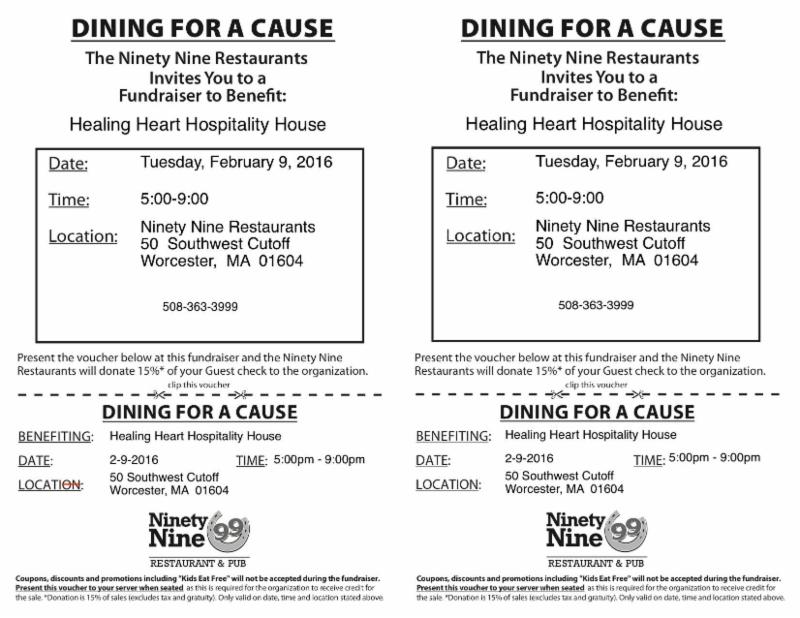
One former SHARE member, Nancy Whalen, the President of Healing Heart Hospitality House, has just let us know about an upcoming dinner with real heart. And you’re invited! “Our mission is to help families of patients traveling more than 30 miles to be with their loved ones hospitalized in the Worcester area by providing a suite of services that offers emotional and spiritual support and comfort,” Nancy writes. “Just recently a very generous person has offered to buy us a house. After 10 years of working towards this goal, we are excited beyond words. Pub 99 is sponsoring our fundraiser by donating 15% of food purchased on Tuesday, February 9th when anyone presents the voucher from 5 p.m. to 9 p.m.”


Healing Heart Voucher.jpg
You can print your own voucher by right-clicking the above image. Save it to your computer, and you can print it from there.

GOING RED for HEART HEALTH


Heart disease and stroke cause 1 in 3 deaths among women each year, killing approximately one woman every 80 seconds.  Fortunately, we can change that because 80 percent of cardiac and stroke events may be prevented with education and action. On Friday, February 5th, many SHARE members participated in National Wear Red Day, wearing red and working to raise research funds and awareness about women's heart health. 
Go Red Raffle in the University Cafeteria


The American Heart Association provides this guide to Well-Woman Visits so that you can schedule, prepare for, and understand the kinds of physician visits that will help you protect your own heart health, and encourage other women to do the same.


SOME GOOD NEWS for the MIDDLE CLASS


The number of union members in the US held steady from 2014 to 2015, according to the annual Department of Labor report on the subject.  Studies show that increased union membership strengthens the middle class.

HEARTS ARE AMAZING

Did you know that the blue whale has the largest heart, weighing in at 1,500 pounds? Or that your heart will beat about 100,000 times today? That will add up to over a million barrels of blood during an average lifetime.

NOT GETTING UPDATES? A TIP for KEEPING on TOP of SHARE NEWS

If you haven't already signed up to receive blog updates by email, you can do so by entering your address in the box in the top right corner of this screen. Also: for those of you who have signed up, but aren't getting updates, make sure to check your inbox--or your spam filter--for a verification email. When you sign up, you'll get an email from "Feedburner Email Subscriptions" asking you to click on the included link; this will activate your email subscription. If you have difficulties, please email kirk.davis@theshareunion.org.

Hope you all had a wonderful weekend, and that things are off to a very good start for you this week. See you here next time . . .