Tuesday, March 29, 2016

Who Gets the Extra Time and the Overtime?

In some areas of the hospital, confusion about the distribution of extra time and overtime still exists. We want to make sure you know that, in our last contract negotiations, we worked with the hospital to make the policy simple and clear, and to prioritize the ability of SHARE members to get ET and OT.


If you would like help making sure that the policy is applied properly in the department, if you have questions about it, or if the SHARE members in your department would like to negotiate something different from the contract provisions, please contact the SHARE office. (Some departments have negotiated different arrangements, ones that are designed to better suit the specific needs of the staff and the work in those locations.)


Here’s the full contract language clarifying how any extra time and overtime should be doled out:


SHARE staff shall have priority over non-SHARE staff to be scheduled for extra time and overtime for SHARE position work. In the absence of guidelines negotiated in the department with SHARE staff, the following guidelines will be used: Regular part-time SHARE staff will have their schedule requests for additional time granted prior to the scheduling of per diem staff. Part-time workers and per diems may be scheduled for additional straight time hours prior to scheduling full-time employees for work at overtime pay.


Once a unit schedule is posted and additional hours need to be filled, they will be offered as follows:
  1. Part-time SHARE staff on unit
  2. Part-time SHARE staff from off unit
  3. Per Diem staff for straight time
  4. Full-time SHARE staff

This policy can be found in the context of all of the contract agreement language on page 11 of the online SHARE contract.

Friday, March 11, 2016

Reaching Contract Agreement: How Harvard Did It

Members of our sister union, HUCTW, have just ratified a new contract with Harvard University, with over 98% of the members voting to approve it. We are happy to congratulate the Harvard Union of Clerical and Technical Workers for voting-in this new contract agreement. 

SHARE and HUCTW have a lot in common. Together, the following unions form a coalition of unions known as the New England Organizing Project, or NEOP:
  • the SHARE unions
    • at UMass Medical School, and
    • at UMass Memorial Hospital,
  • the Union of Social Workers at Cambridge Health Alliance, and
  • the Harvard Union of Clerical and Technical Workers (or HUCTW)
Our shared vision includes a shared negotiation philosophy. In our negotiations, both HUCTW and SHARE begin by talking with management about what's important to union members. We listen carefully to what management says is important to them. Some of our goals overlap with those of management, and, of course, some do not. SHARE tries to build on our common ground, though we know we will disagree about other things. Before we start arguing what size piece of the pie we are going to get, we first want to figure out what we can do to grow that pie bigger. We look for ways to find solutions that work for both sides.

Union members got involved at Harvard to show their support for the union's ideas about healthcare. The NEOP unions agree: What happens outside the negotiating room, with union members showing their support, is just as important as what happens inside the negotiating room.

HUCTW and Harvard came to a contract agreement after long negotiations. As Harvard’s student newspaper, The Crimson, reports, Harvard’s most recent negotiations were long and frustrating. To focus discussions and hone interests, HUCTW and the University involved a team of professional mediators.

You can visit the HUCTW website to find a summary of the outcomes, as well as the complete language of the tentative agreement which has since been ratified by the members.
Every negotiation is different, from institution to institution, and with each successive contract. The next SHARE negotiations will evolve based on the interests of SHARE members and the needs of our hospital.  The strong success at Harvard inspires us to further develop our interest-based negotiation methods as we work to advance our wages and benefits, and create new and ambitious structures for improving our workplaces.

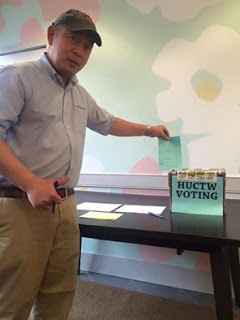
HUCTW member Noel voting in his first ratification vote at Harvard's Dumbarton Oaks location. Employees at this site, located in Washington D.C., recently voted to join Harvard's union.

Sunday, March 6, 2016

SHARE PCAs, LPNs, and MAs – Do you want to go back to school?

SHARE, Worcester State University and UMass Memorial have put together a program to help you get started at college.

It's affordable, at a convenient time and place, and not scary! This program is designed for people who may not have been in a classroom for a long time. You earn 9 or more college credits, which you can transfer to other colleges if you want. You get coaching and support, and you get help making a plan for continuing your education at the end. Your classmates will be other SHARE members in the same boat.

Convenient time: You can do the classes during the day or in the evening. The first group will meet one evening per week (Wednesdays 4:30-7:30pm), starting in April 13th and going through October. A second group will go to classes during the day, starting September 2016 and going through April 2017.

Convenient locations – All classes located at University, Memorial or Hahnemann campuses.

Affordable – The first "getting started" class is free to you – UMass Memorial will pay for it! For the next three classes (3 credits each), you get tuition remission from UMass Memorial for much of the cost. UMass Memorial has agreed to pay that amount up front so that you don’t have to come up with the money ahead of time, like you usually have to -- which is awesome. (If you start but don’t finish a class, you will have to pay back the money.)

The best way to find out more or sign up that you are interested is to come talk to Amy from Worcester State at drop-in info sessions in the cafeterias:
·       Wed, 3/9 University: 11:30am - 1:30pm and 4:30pm - 6:30pm
·       Wed, 3/16 Memorial: 11:30am - 1:30pm and 4:30pm - 6:30pm
·       Wed, 3/23 University: 11:30am - 1:30pm and 4:30pm - 6:30pm
·       Wed, 3/30 Memorial: 11:30am - 1:30pm and 4:30pm - 6:30pm

To sign up: You can go to OurNet then My HR. Look for "Learning" and click on that. Look for the Direct Care Workers Pathways Program. You can also find it on the Worcester State University website.

If you can't find the information, you can call SHARE and we will get you a brochure -- leave a message at 508-929-4020 ext. 10.


Please note:  A state grant is paying for part of this program, and the state limited the program to people currently working as Patient Care Assistants, Licensed Practical Nurses, and Medical Assistants (or Medical Office Assistants). We wish we could make this opportunity available to all SHARE members – if this grant goes well, maybe we can do that in the future!

Sunday, February 7, 2016

Tidbit Time: Week of February 8, 2016

Happy Heart Month! As in, happy Valentine’s. And, more importantly, Heart Health Awareness Month. Here’s our latest roundup of tidbits from our community and the worlds of academia, healthcare, and unions . . .


SUPPORTING FAMILIES and FRIENDS of WORCESTER PATIENTS


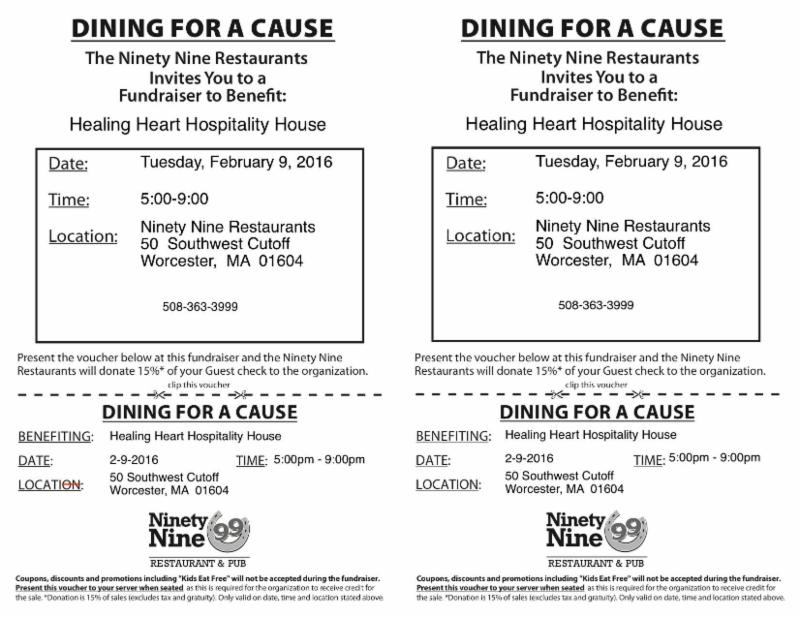
One former SHARE member, Nancy Whalen, the President of Healing Heart Hospitality House, has just let us know about an upcoming dinner with real heart. And you’re invited! “Our mission is to help families of patients traveling more than 30 miles to be with their loved ones hospitalized in the Worcester area by providing a suite of services that offers emotional and spiritual support and comfort,” Nancy writes. “Just recently a very generous person has offered to buy us a house. After 10 years of working towards this goal, we are excited beyond words. Pub 99 is sponsoring our fundraiser by donating 15% of food purchased on Tuesday, February 9th when anyone presents the voucher from 5 p.m. to 9 p.m.”


Healing Heart Voucher.jpg
You can print your own voucher by right-clicking the above image. Save it to your computer, and you can print it from there.

GOING RED for HEART HEALTH


Heart disease and stroke cause 1 in 3 deaths among women each year, killing approximately one woman every 80 seconds.  Fortunately, we can change that because 80 percent of cardiac and stroke events may be prevented with education and action. On Friday, February 5th, many SHARE members participated in National Wear Red Day, wearing red and working to raise research funds and awareness about women's heart health. 
Go Red Raffle in the University Cafeteria


The American Heart Association provides this guide to Well-Woman Visits so that you can schedule, prepare for, and understand the kinds of physician visits that will help you protect your own heart health, and encourage other women to do the same.


SOME GOOD NEWS for the MIDDLE CLASS


The number of union members in the US held steady from 2014 to 2015, according to the annual Department of Labor report on the subject.  Studies show that increased union membership strengthens the middle class.

HEARTS ARE AMAZING

Did you know that the blue whale has the largest heart, weighing in at 1,500 pounds? Or that your heart will beat about 100,000 times today? That will add up to over a million barrels of blood during an average lifetime.

NOT GETTING UPDATES? A TIP for KEEPING on TOP of SHARE NEWS

If you haven't already signed up to receive blog updates by email, you can do so by entering your address in the box in the top right corner of this screen. Also: for those of you who have signed up, but aren't getting updates, make sure to check your inbox--or your spam filter--for a verification email. When you sign up, you'll get an email from "Feedburner Email Subscriptions" asking you to click on the included link; this will activate your email subscription. If you have difficulties, please email kirk.davis@theshareunion.org.

Hope you all had a wonderful weekend, and that things are off to a very good start for you this week. See you here next time . . .

Monday, February 1, 2016

SHARE 2016 Contract Negotiations Survey: The Results Are In

Thank you again to the 1651 SHARE members who completed the 2016 Contract Negotiations Survey. The survey focused on how to improve the day-to-day experience at work because that is where we want to focus in this year's contract negotiations. The survey results will be extremely helpful to the SHARE Negotiating Team.

Highlights: 

  • The great majority of SHARE members find meaning in their work providing healthcare. 
  • SHARE members value their benefits. 
  • SHARE members say they get too little respect and appreciation for the important work that they do. 
  • SHARE members are frustrated about their workload and staffing levels. 

You can see the full results online here


What are SHARE members MOST satisfied with?


SHARE Members Love their Benefits

Satisfaction with benefits was the highest ranked of the items that SHARE members reported their satisfaction with, with 85% saying they were either very satisfied or satisfied with benefits in general. This finding echoes SHARE members’ opinions as reported on the SHARE benefits survey from 2014, where 93% of SHARE members who took the survey said benefits are an important reason why they continue to work here. Over the years, SHARE members and the Negotiating Team have spent a lot of time and energy negotiating to keep and improve these benefits, so it's good to know that SHARE members appreciate them! 

Doing Something Meaningful in Providing Quality Healthcare

Doing something meaningful in providing quality healthcare was a close second in satisfaction, with 79% of SHARE members saying that they were satisfied on that question. People wrote lots and lots of comments about how much they love their patients, and their work with them.

What are SHARE members LEAST satisfied with?

Staffing

Only 45% said they were satisfied with their workload. On another question, 41% disagreed with the statement that staffing levels are adequate in their department, which was one of the highest negative responses to a question in the survey. Lots and lots of people wrote comments about how staffing challenges affect their experience at work, and patient care.

Only “informed about policies and administrative decisions” came in as less satisfying than workload, with 43% saying they were satisfied with this.

Respect at Work

SHARE members who took the survey were asked to rank a bunch of things in response to “What most important to improving your day-to-day experience at work?” The items you could choose from included: “respect and how my department leaders treat people; job security; feeling like a team in my department; systems, fixing how the work gets done; getting breaks and lunch and vacation time; and learning new things, career development.

Over two-thirds of SHARE members, 69% of those who took the survey, ranked “Respect and how my department leaders treat people” as number 1 or 2 out of that list, considerably more than any other item.

SHARE members report a wide range of opinions about their supervisors and managers: There are positive comments about how some managers seek out and listen to input from their staff, support their staff, and show respect for everyone and everyone’s work. There are also plenty of negative comments by SHARE members who say that their supervisor or manager does not listen to their input, or micromanages their work. When asked to agree or disagree with “I have an opportunity to participate in decisions made by my supervisor that affect my work environment,” SHARE members are evenly split. 34% say they agree with the statement, and 32% disagree with the statement. (The remaining 34% chose “neutral.”)

Job Security

Second in that ranking of priorities for improving day-to-day work was job security, with 53% ranking it number 1 or 2. And 30% agree that they worry about getting laid offs from their jobs.

Many SHARE Members Want to Learn Something New

73% of SHARE members say Yes or Maybe to wanting to learn new skills for a different job, plus 9% who say they are already in school to learn something new. Clearly there’s a hunger out there among SHARE members to keep learning and growing at UMass Memorial.


What's next?

These major themes are not a great surprise--these are issues that come up regularly in conversation with SHARE members. However, having numbers to attach to these stories gives us new insights, and documentation of what we hear day-to-day. We will continue to analyze the data, looking for patterns, and which groups of SHARE members feel most strongly on which issues. Stay tuned.

Monday, January 25, 2016

Annual UMass Martin Luther King Day Speaker: Liz Walker

Reverend Liz Walker with SHARE Treasurer Sandra Alafberg
Last Wednesday, the Reverend Liz Walker from the Roxbury Presbyterian Church spoke to our community about Martin Luther King and his example, especially how he lived a life of grace. 

SHARE Hospital Treasurer Sandra Alafberg, who works in downtown Worcester at UMass Memorial's Central Business Office, took time off from her work to hear Ms. Walker's talk, and left the event inspired and moved. 

"I loved it. Liz Walker is down-to-earth. Gracious . . . and funny. She's a humanitarian." Sandra said of the speaker. "She's from Arkansas. She learned about Dr. King when she was a girl. But she didn't come to talk about politics and movements. She talked about Martin Luther King being punched in the face by a man who was a stranger to him, and how he got up and walked away, how he showed grace. She talked about meeting Sudanese people who had absolutely nothing, and about their grace. She talked about how graciousness can change workplaces and societies." 

As a former news anchor at WBZ, Liz Walker is a familiar face to many in Massachusetts. Following in Dr. King’s tradition of service and advocacy, Liz Walker has responded to her own historical moment by co-founding the Jane Doe Safety Fund, a multi-million dollar advocacy group for survivors of domestic violence, and serving on a number of community boards and groups dedicated to causes including HIV/AIDS, breast cancer, and at-risk youth. She currently divides her time between Massachusetts and the Sudan, where she does humanitarian work as the founder of "My Sister's Keeper," a group that focuses on economic and educational initiatives for Sudanese women and girls. You can learn more about Liz Walker’s work on her own website.

Tidbit Time: Week of January 25, 2016

Welcome back! These tidbits are starting to add up. Speaking of adding up . . .

MORE PARTICIPANTS, EASIER WORK

“Many hands make light work” has become a fairly well-known aphorism. The phrase can be attributed to the English playwright John Heywood, who wrote during the sixteenth century. The idea can also be found in many other languages around the world. A related Tanzanian proverb says, “Two ants do not fail to pull one grasshopper.”

ONE BILLION ACTS of PEACE

Here, Chade-Meng Tan explains how cooperation can change the world, in describing a project undertaken by Tibetan students in India that is doing just that.

JANUARY IS NATIONAL BLOOD-DONOR MONTH

The Blood Donor Center at UMass Memorial accepts the important gift of blood year-round, and January is a great time to resolve to give. Blood is required for a number of medical conditions, including, of course, transplants, cancers, and traumatic injuries. UMass Memorial uses about 31,000 blood products each year to meet the needs of patients. The Blood Donor Center is located on the University Campus, downstairs from the Emergency Department. Walk-ins are welcome for whole-blood donations, or to schedule an appointment, please call 508-421-1950. To find other locations to give, visit the Red Cross website 

LEARN IT and KEEP IT

In his book Outliers, writer Malcolm Gladwell develops the idea that it takes roughly ten thousand hours of practice to achieve mastery in a field. Many critics and studies have worked to debunk this theory. Author and podcaster Tim Ferriss aspires to teach readers how to be world-class performers in a fraction of that time. But how long does it take to lose a skill? HopesandDreams recently spoke with several leading experts to find out the answer.

BUT HOW MANY LICKS DOES IT TAKE to GET to the CENTER of a TIDBIT?

A tidbit is, as Merrium-Webster tells us, “a choice or interesting bit (as of information),” or “a small piece of news or information.” Outside of the US and Canada, the preferred spelling is “titbit.” Obviously the word also often refers to a select little piece of food, and grammarist.com tells us that “the first syllable likely comes from the archaic colloquialism tid, meaning tender.

Hope you all had a wonderful weekend, and that things are off to a very good start for you this week. See you here next time . . .