Monday, August 8, 2016

Contract Negotiations Side Tables


 SHARE and UMass Memorial are trying something new in our negotiations this time. As you may remember from our last round of negotiations, SHARE and UMass Memorial management had a side table to discuss changes to the pension, before we started negotiations about the rest of the issues. The Pension Table brought together people from both union and management to focus in-depth on the pension, which worked quite well.

This time, we are building on that success. Multiple side tables will meet in the afternoons after the Main Table meets. These smaller groups can focus on their issue and bring recommendations to the Main Table.
  •  Teams & Culture Side Table– This side table (who might change their name once they get started) is looking at examples of team-based work systems in other places to see what we want to try here at UMass Memorial. At Kaiser Permanente, unit based teams help groups do process improvement to make the work easier, and train everyone on how to work together as a team.  SHARE believes a team structure also could improve how SHARE members and supervisors and managers work together, which was a big priority coming out of the SHARE member survey last fall (link to SHARE letter and survey results). 
  • Career Development Side Table – SHARE wants to increase ways for SHARE members to learn and grow in their jobs and to build careers at UMass Memorial. A group will also discuss how internal applications and transfers are working.
  • In-patient PCA Staffing Side Table – This side table will look at how the patient care model is working on the inpatient floors. SHARE hopes to address PCAs’ concerns about how many patients they have to provide care for. (Staffing is a big concern for many SHARE members – we will be discussing staffing for other areas at the Main Table.)
  • Call-Back and Sleep Time Side Table – This side table is tackling issues for SHARE members who take call.
  • In addition, mini side table groups will discuss salary scales for peer-slotted titles in SHARE, the pension floor to protect lower paid SHARE members, and 401K auto-enrollment for new employees.

 Our hope is that side tables will help us get more done quickly in negotiations, and bring more new ideas into the negotiations. We’ll keep you posted.

Contract Negotiations: Negotiating about How to Negotiate


 Joel told the packed classroom, “There are three keys to a successful negotiation: preparing, preparing, preparing.” We were there--almost forty of us, both members of the SHARE and UMass Memorial management Negotatiating Teams and leaders, in a series of three half-day training sessions--to learn about different ways of negotiating.

In past Contract Negotiations, SHARE has used a model of bargaining that begins with open conversation about interests – what each side cared about. We’ve worked toward “expanding the pie”, rather than fighting over who’s getting the bigger piece of pie. When we try to focus on our common ground, we are more likely to find “win-win” solutions.

In these negotiations, SHARE is focusing on the day-to-day experience of coming to work for SHARE members. Taking on this huge issue makes it even more important that SHARE and management be able to negotiate productively. SHARE and UMass Memorial management have agreed to use Interest Based Bargaining to try to craft solutions for a better way of working at UMass Memorial.


Our teacher and facilitator for these trainings was Joel Cutcher-Gershenfeld. He’s a professor at the Heller School for Social Policy and Management at Brandeis University. He has studied labor-management partnership in the Kaiser Permanente hospital network. He also helped Ford and the United Auto Workers Union to form a Labor Management Partnership. That partnership helped Ford so much they were the only major US automaker that didn’t require federal funding during the recent industry bailout. More important to us than all his academic accomplishments: Joel’s been a huge to both union and management in guiding us forward.

Sunday, August 7, 2016

Respect and What SHARE Members Think Makes a Good Supervisor or Manager

In the SHARE survey, 70% of SHARE members rank respect and how department leaders treat people as a high priority for improving their day-to-day experience at work, higher than any other item on the list. In our survey, SHARE members had a lot to say about what makes managers and supervisors helpful in making their department run better, as well as what their managers could do better.

Here are some of the ideas the SHARE Negotiating Team brought to the table in the discussion about how to improve supervisor and manager interactions with SHARE members.

How some managers show respect and help the department run better:
  • Involve staff in decisions, ask our opinions
  • Share information often & with everyone
  • Pitch in when we are short-staffed
  • Good listener, and available
  • Open to new ideas
  • Treat everyone fairly
  • Help us fix problems
  • Give recognition for hard work

What other managers do that does not help the department run better:
  • Micro-manage – not trust staff to do their jobs
  • Favoritism: Treat some people better than others
  • Criticize someone in front of co- workers or patients
  • Think s/he knows best
  • Not understanding the work we do
  • “Run hot and cold” or add drama to the workplace

 In SHARE’s opinion, UMass Memorial has had a culture of a “command and control” style of managing over the years. Not every manager for sure, but in general. In contract negotiations we are talking with management about how we can together move UMass Memorial toward a new more supportive and collaborative model of managing. We don’t know exactly how to do that, but we’re working on it!

Friday, July 29, 2016

Free Online Associate Degrees for SHARE Members

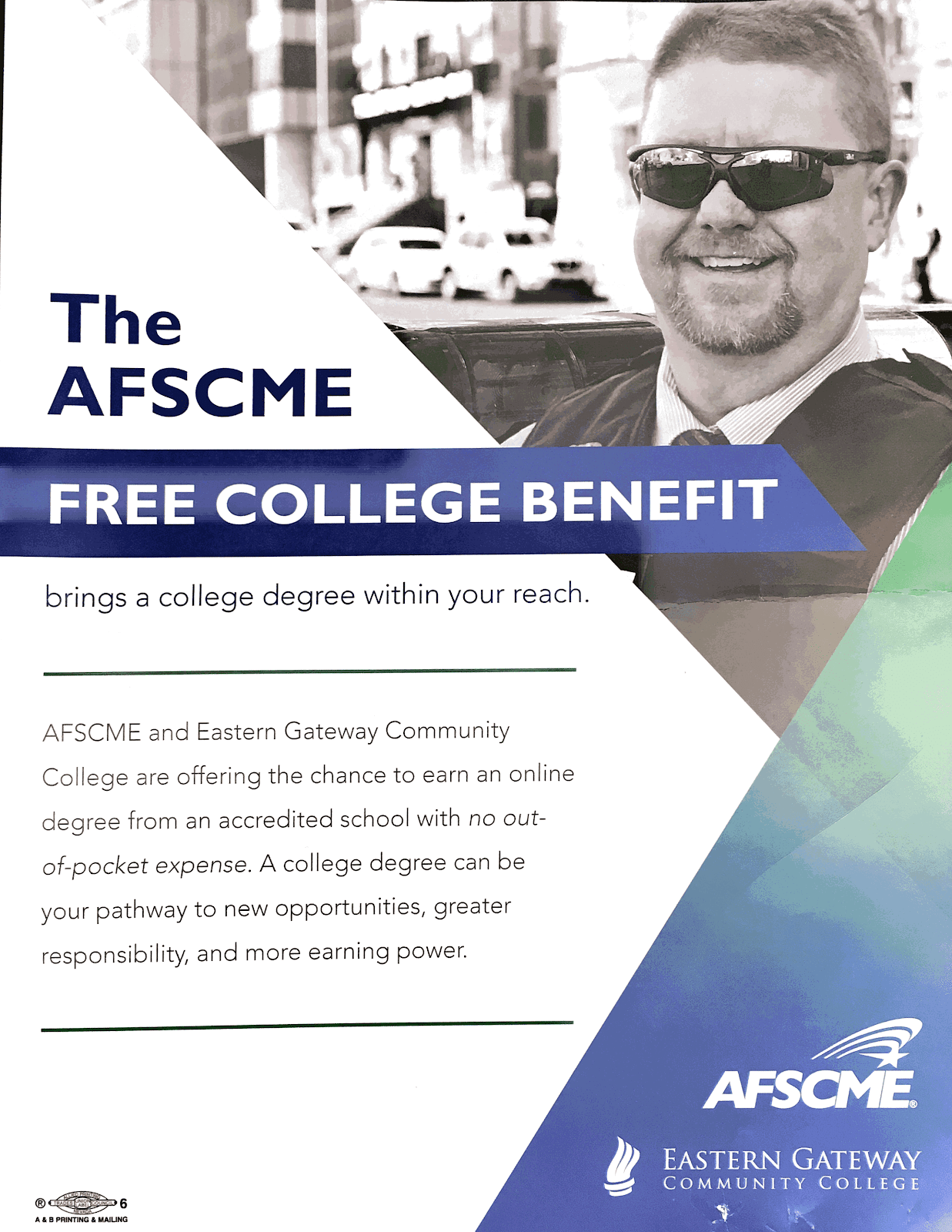
IMG_0981.PNGAs a SHARE member, through the AFSCME Free College Benefit, you and your family can now earn an associate degree completely online–for FREE. SHARE leaders learned about this new program when it was announced last week at the AFSCME International Convention.

The benefit is offered through our parent organization, AFSCME, in cooperation with Eastern Gateway Community College, to provide members and their families “the chance to earn an online degree from an accredited school with no out-of-pocket expense,” as described on the program flyer. The program is open to active and retired AFSCME members, their children, and dependents.

The degree programs are currently limited to Associate of Business Management, Associate of Criminal Justice, and Associate of Arts (which can be used to progress into baccalaureate programs including psychology, sociology, English, history, fine arts, and communications). An Early Childhood Education degree will be offered beginning next year. 

The program is designed to welcome traditional as well as non-traditional students, including those who have been out of school for a long time, and to be flexible, allowing participants to work while earning their degree. And the degrees are designed to parallel the first two years of related Bachelor's Degree programs to make the coursework transferable.

Learn how the program works by clicking HERE.

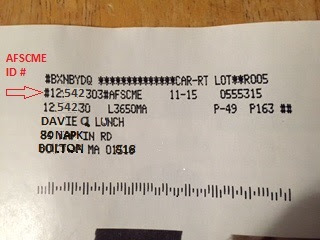
The application process involves submitting a simple application form, along with a completed FAFSA form, and school transcripts. Applicants are required to include their AFSCME member number. Although SHARE does not receive information about member numbers, we will be happy to help you find out yours. If you receive mailings to your home from AFSCME, including the AFSCME Works magazine, you can find that number on the address label. Your ID number will look something like this:


SHARE is extremely excited for this new offering. If you run into difficulty finding answers to any questions, we're happy to help: please call the SHARE office at 508-929-4020.

Wednesday, July 20, 2016

SHARE PCAs, LPNs, and MAs – Do you want to go back to school? A great opportunity is back!


Last year, SHARE, Worcester State University and UMass Memorial put together a program to help direct caregivers get started at college. We are excited that the Pathways Program has been so successful that WSU is currently preparing for the next wave of classes. To learn more about how you can take advantage, join coordinator Amy Ebbeson at one of the drop-in information sessions listed on the below flyer. You can also contact her directly by phone at (508) 929-8416, or email aebbeson@worcester.edu.

Why?

It's affordable, at a convenient time and place, and not scary! This program is designed for people who may not have been in a classroom for a long time. You earn 9 or more college credits, which you can transfer to other colleges if you want. You get coaching and support, and you get help making a plan for continuing your education at the end. Your classmates will be other SHARE members in the same boat.

Convenient time: You can do the classes during the day or in the evening. The first group will meet one evening per week (Wednesdays 4:30-7:30pm), starting in April 13th and going through October. A second group will go to classes during the day, starting September 2016 and going through April 2017.

Convenient locations – All classes located at University, Memorial or Hahnemann campuses.

Affordable – The first "getting started" class is free to you – UMass Memorial will pay for it! For the next three classes (3 credits each), you get tuition remission from UMass Memorial for much of the cost. UMass Memorial has agreed to pay that amount up front so that you don’t have to come up with the money ahead of time, like you usually have to -- which is awesome. (If you start but don’t finish a class, you will have to pay back the money.)


To sign up: You can go to OurNet then My HR. Look for "Learning" and click on that. Look for the Direct Care Workers Pathways Program. You can also find it on the Worcester State University website.


Please note:  A state grant is paying for part of this program, and the state limited the program to people currently working as Patient Care Assistants, Licensed Practical Nurses, and Medical Assistants (or Medical Office Assistants). We wish we could make this opportunity available to all SHARE members – if this grant goes well, maybe we can do that in the future!

Tuesday, June 14, 2016

Phasing Out of "Spousal Coordination"

Good news for SHARE members who have had to deal with "spousal coordination" of their family health insurance -- it's going away!

Spousal coordination required SHARE members hired after 7/1/2008 to put their spouse on the spouse's employer's health insurance, if possible, even if the SHARE member purchased a family plan to cover children. UMass Memorial reimbursed the cost of the spouse's individual plan, and paid any extra to "top off" the spouse's coverage so that the employee didn't lose anything. It was supposed to cost no more to the SHARE member, but save UMass Memorial money.

UMass Memorial had proposed the plan to SHARE, feeling that area companies rely on the hospital's good health insurance coverage for spouses, saving those other companies money.

SHARE members thought spousal coordination was confusing, and a lot of paperwork to get reimbursed.

SHARE (and probably many others) had complained about spousal coordination to Human Resources. We asked if it really did save the hospital money, once the additional work was taken into account.

Human Resources has decided to discontinue the plan this year: New employees won't be signed up for it starting now, and SHARE members who already have won't anymore in the next health insurance year, starting January 2017.

HR has told SHARE that they are committed to helping SHARE members with the transition if there are problems with the timing of the spouse's health insurance year.

Monday, June 13, 2016

Solidarity


Our thoughts and prayers are with the victims of the Orlando Pulse Nightclub Shooting, their families and their friends. 

We stand in solidarity with all those affected by this senseless violence, directly or indirectly, and especially with our own LGBTQ, Latino, and Muslim communities here at UMass Memorial Hospital and UMass Medical School.​